Main caveat
It appears promising and unusually feature-rich, but it is far less established than bigger platforms here, and the reviewed docs point mainly to Div-idy-hosted URLs rather than custom domains.
Alphabetical benchmark profile
Builders who want a very prompt-first workflow with built-in growth tooling and easy publishing to a hosted URL.
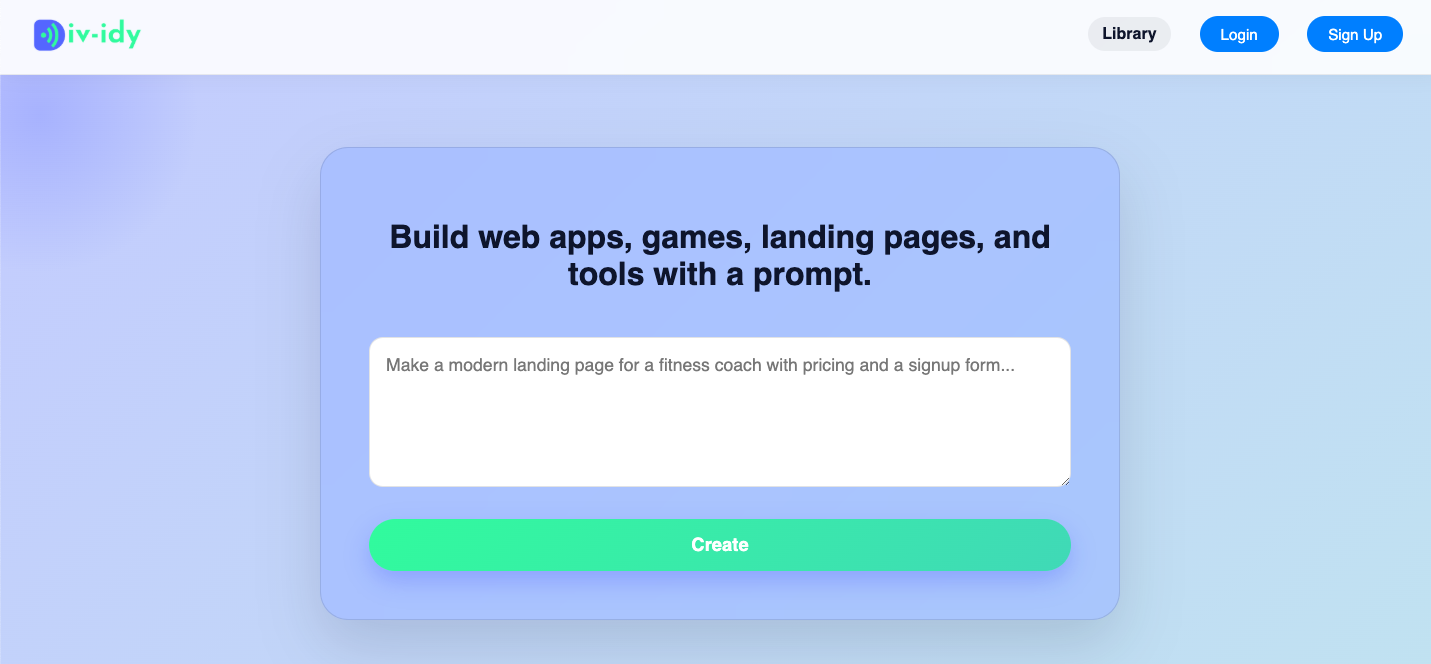
Div-idy is best for Builders who want a very prompt-first workflow with built-in growth tooling and easy publishing to a hosted URL. Main caveat: It appears promising and unusually feature-rich, but it is far less established than bigger platforms here, and the reviewed docs point mainly to Div-idy-hosted URLs rather than custom domains.
Official source domains reviewed 2026-04-28. Page last reviewed 2026-04-30.Builders who want a very prompt-first workflow with built-in growth tooling and easy publishing to a hosted URL.
It appears promising and unusually feature-rich, but it is far less established than bigger platforms here, and the reviewed docs point mainly to Div-idy-hosted URLs rather than custom domains.
div-idy.com
| Question | Report verdict and notes |
|---|---|
| Do I need coding knowledge? | No. |
| Database integration | Native. Div-idy’s FAQ says it includes a real-time database for forms, leads, and app data. |
| A/B testing integration | Native. Div-idy documents an A/B Tests tool for variants and traffic-splitting. |
| Ecommerce integration | No official first-party ecommerce/store suite found in the docs reviewed. The platform talks more about ads, affiliate monetization, and custom app flows than a built-in commerce stack. |
| Ad integration | Native. Div-idy documents an Ads tool and related setup guidance. |
| SEO integration | Native. The platform documents metadata, sitemaps, and indexable public projects. |
| Analytics integration | Native. Div-idy documents an Analytics tool for sessions, events, sources, and trends. |
| Can I build by typing a prompt? | Yes. |
| Can I edit an existing project with a prompt? | Yes. |
| Do I need to buy a domain to go public? | No. Div-idy says you can publish to a shareable Div-idy URL without domain setup. In the reviewed FAQ, using your own domain was not confirmed as a supported workflow. |
| How publishing works | One-click publish to Div-idy-hosted URLs with private, unlisted, or public visibility. Public projects can be indexed and shared easily. |
| Can I build video games? | Yes for browser games and game-like experiences. |
| Can I build surveys that save responses? | Yes. Forms can save submissions to the built-in database. |
| Can I build multi-user web apps? | Yes for database-backed tools and multi-user style web apps, though the exact auth depth is less documented than larger platforms. |
| Can I share projects/apps easily? | Easy. |
This profile uses the source spreadsheet row for Div-idy and the official domains reviewed on 2026-04-28: div-idy.com.
The best-fit summary, caveat, database, A/B testing, ecommerce, ads, SEO, analytics, prompt workflow, publishing, survey, multi-user app, and sharing answers come from the same structured source row.
No.
Native. Div-idy’s FAQ says it includes a real-time database for forms, leads, and app data.
Native. Div-idy documents an A/B Tests tool for variants and traffic-splitting.
No official first-party ecommerce/store suite found in the docs reviewed. The platform talks more about ads, affiliate monetization, and custom app flows than a built-in commerce stack.
Native. Div-idy documents an Ads tool and related setup guidance.
Native. The platform documents metadata, sitemaps, and indexable public projects.
Native. Div-idy documents an Analytics tool for sessions, events, sources, and trends.
Yes.
Yes.
No. Div-idy says you can publish to a shareable Div-idy URL without domain setup. In the reviewed FAQ, using your own domain was not confirmed as a supported workflow.
One-click publish to Div-idy-hosted URLs with private, unlisted, or public visibility. Public projects can be indexed and shared easily.
Yes for browser games and game-like experiences.
Yes. Forms can save submissions to the built-in database.
Yes for database-backed tools and multi-user style web apps, though the exact auth depth is less documented than larger platforms.
Easy.
Compare it against tools in the same buyer path, especially the capability map and tools index.